WiFi Settings
SPR Compability
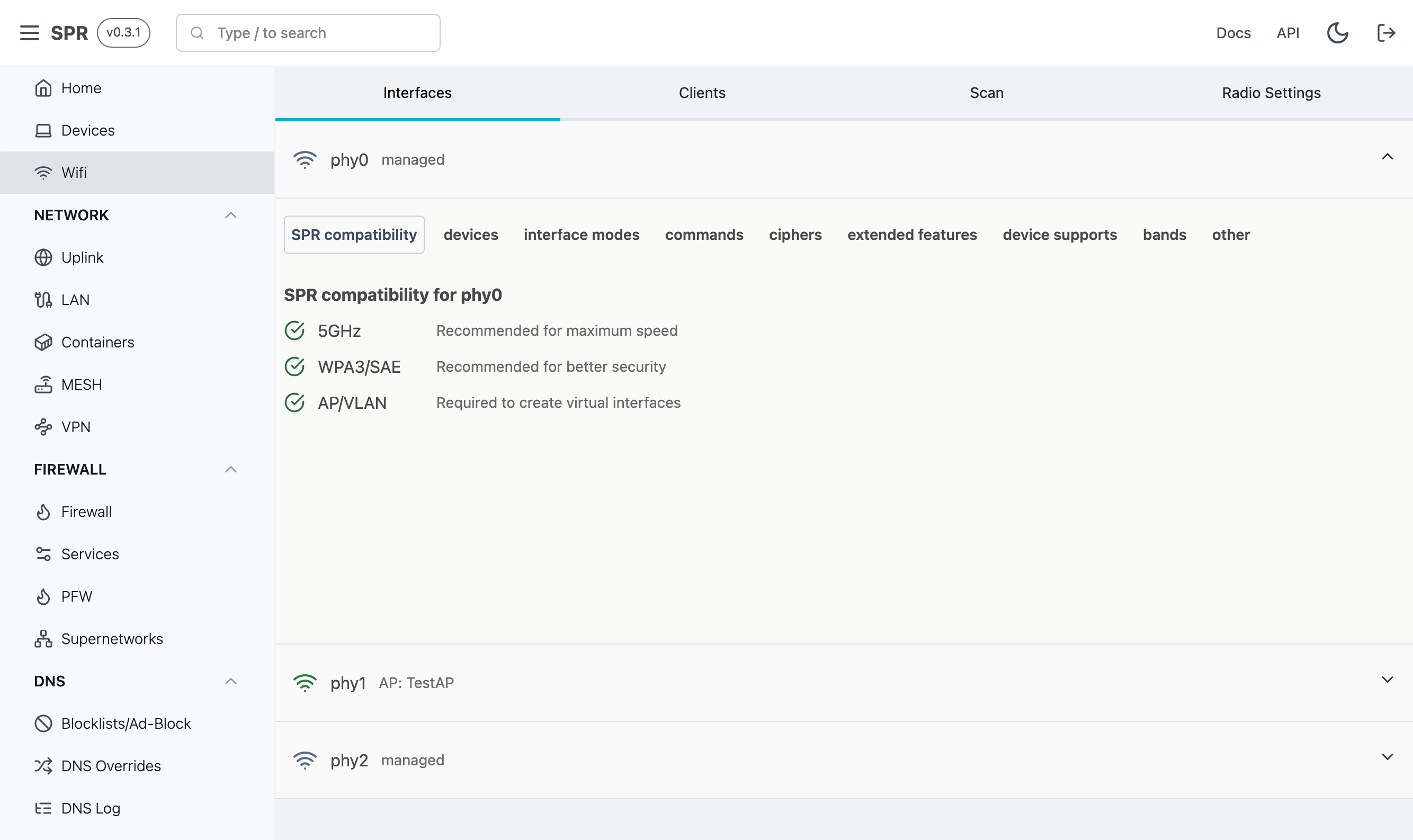
Device isolation today requires a card with AP/VLAN support. This is presented under the Intefaces tab under wireless settings.
SSID
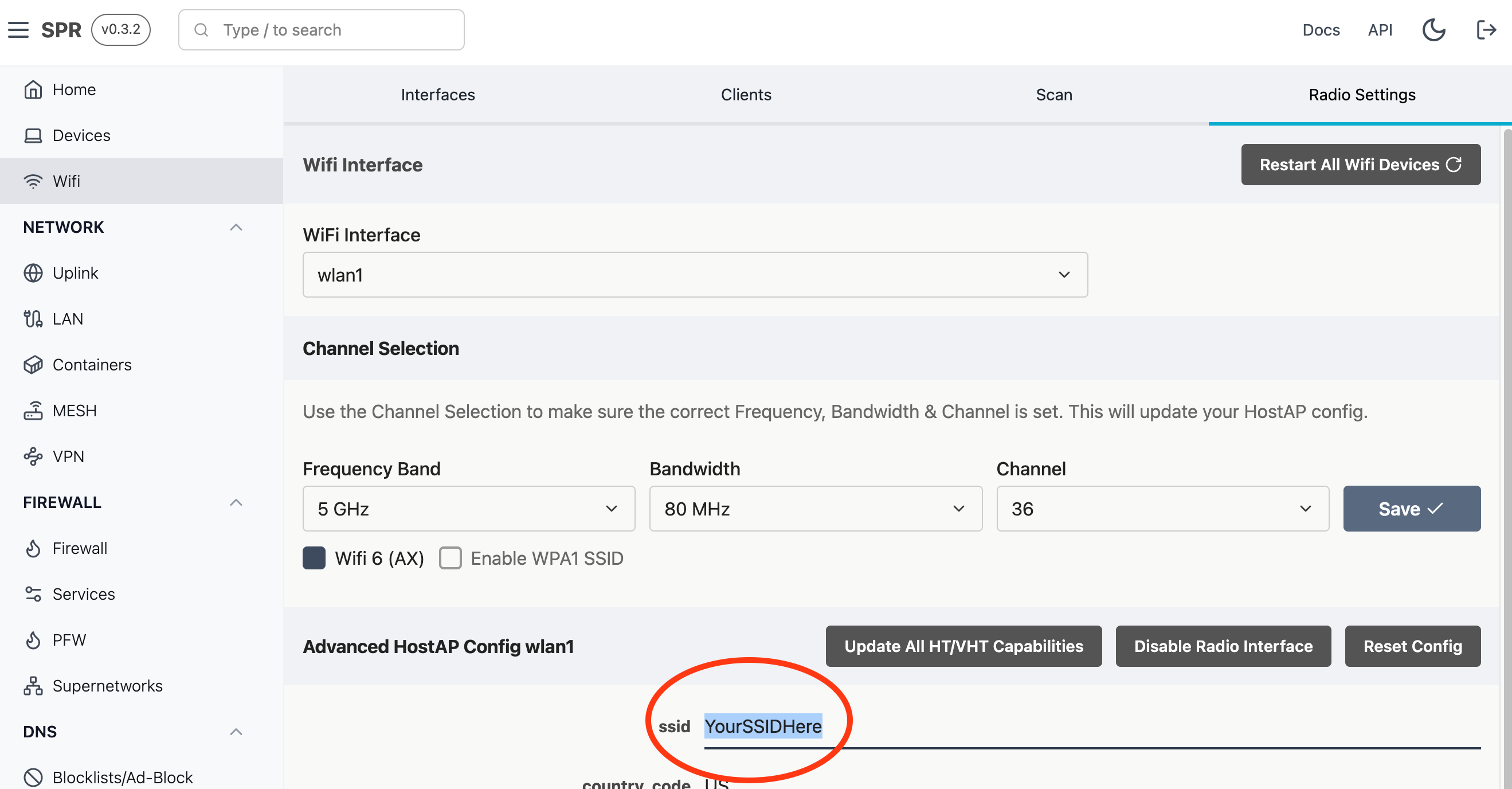
The SSID name can be set by navigating to WiFi ⇨ Radio Settings and typing in the new SSID. After hitting enter or leaving the field, it will update and restart with the new SSID.
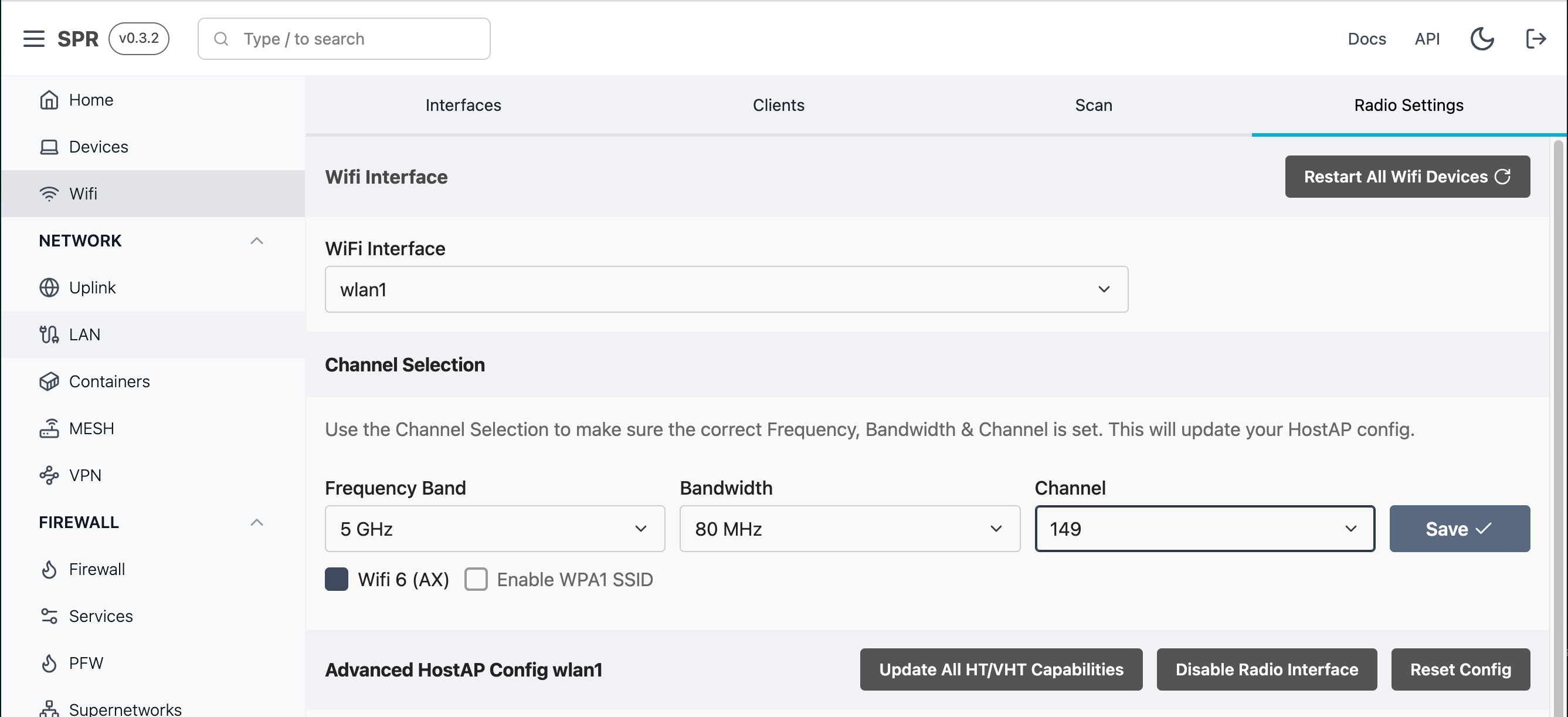
Channel Configuration
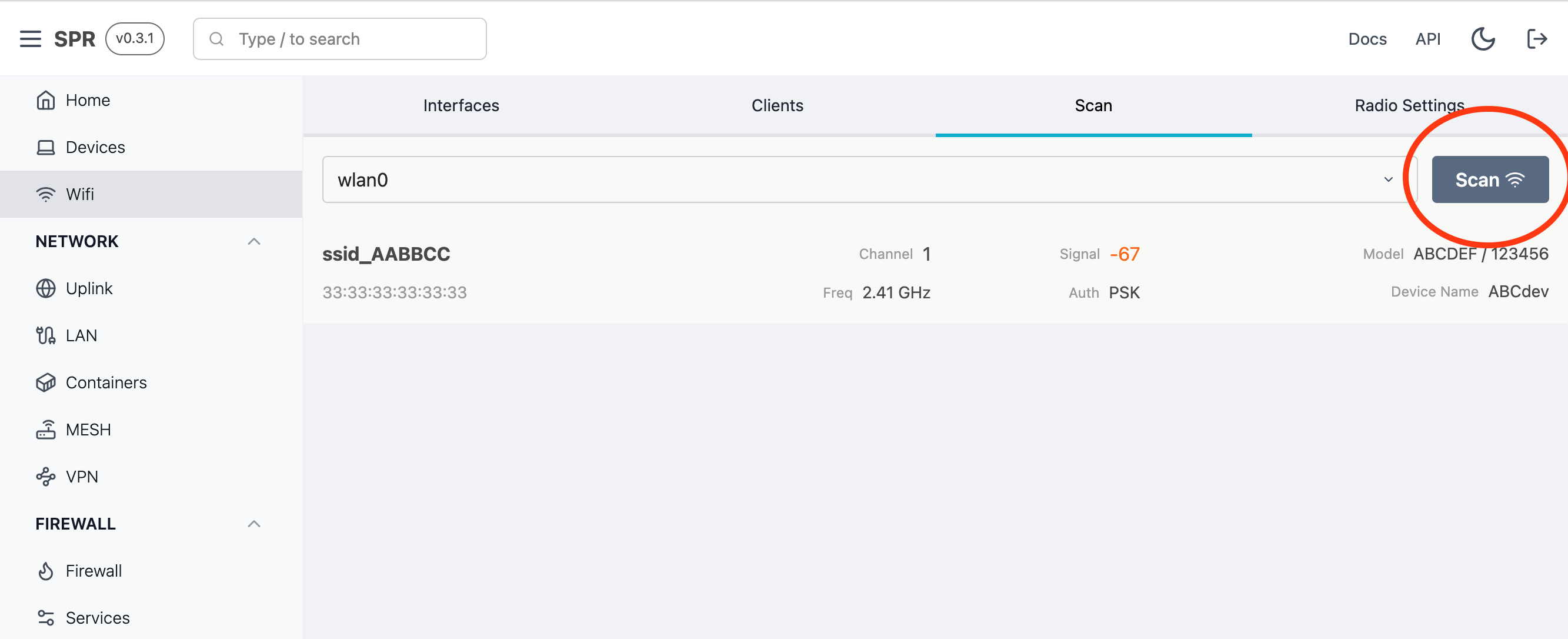
You can also run a scan with an unused radio to try to determine available channels
Enabling WiFi 6
SPR will detect if WiFi 6 is supported. If so, select the WiFi 6 button and hit save. This will configure the AP settings to support WiFi 6 protocol settings.
Guest Networks
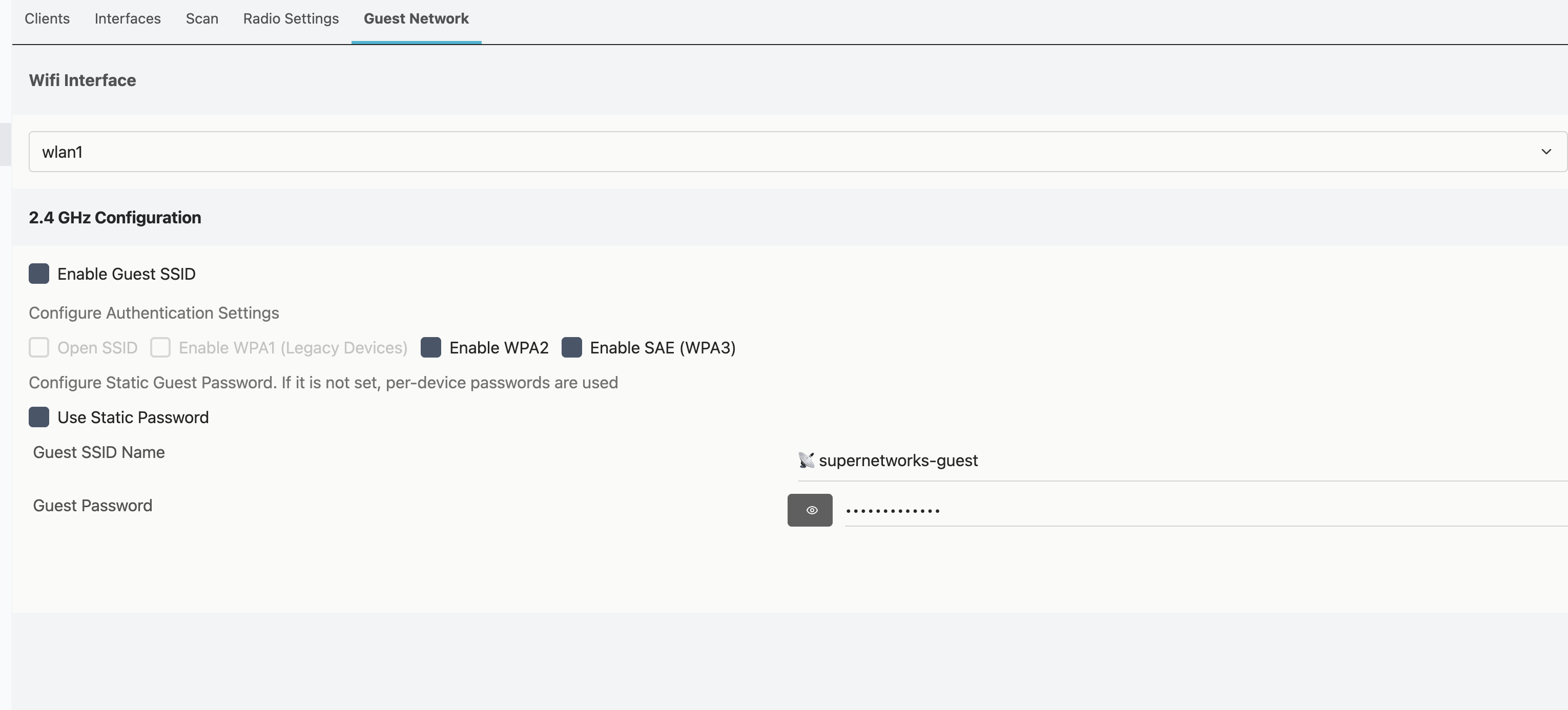
SPR supports loading a Guest Network when the hardware supports it.
Legacy WPA1 Support
Unfortunately, some older devices do not support WPA2 or WPA3. If your card supports it, SPR can enable WPA1 on the Guest SSID.
Tuning Capabilities
There are various capabilities available for 802.11 HT , 802.11AC (VHT), and 802.11AX (HE). SPR will auto-detect and assign these capabilities with the "Update All" button. They can also be selectively modified.
If you need additional options, please file an issue
Fast Roaming (802.11r/k/v)
When you run more than one access point on the same SSID — extra radios or mesh nodes — these 802.11 amendments help clients hand off cleanly as they move:
- 802.11k (neighbor reports) lets a client ask the AP for a list of nearby APs on the same network, so it can find a better roam target without a slow full scan. SPR enables this by default: the hostapd template sets
rrm_neighbor_report,rrm_beacon_report, andrrm_link_measurement_report. - 802.11v (BSS Transition Management) lets the AP suggest that a client move to a specific, better AP. It is controlled by the per-radio
bss_transitionoption, which is off by default. SPR's assisted roaming relies on 802.11v to steer clients, sobss_transitionmust be enabled on both the source and target interfaces before a hand-off can be sent. - 802.11r (Fast BSS Transition) speeds up re-authentication when a client roams, making the hand-off near-seamless (useful for voice and video). It is available in hostapd but is not turned on in SPR's default build.
Network-assisted roaming
Beyond letting clients decide on their own, SPR can actively steer them toward the best AP. The Wi-Fi service watches the network topology and, for each Wi-Fi client whose signal drops below a threshold, looks for another AP broadcasting the same SSID and sends an 802.11v BSS transition request to move the client there. Each attempt is observed afterward and recorded, and a small learning model tracks which transitions actually improve signal so future decisions get better.
This feature stays off unless the /configs/wifi/roam_enable flag file is present. While it is off, the roaming endpoints report disabled and no transitions are sent.
Configuring roaming
Assisted roaming is configured through the API rather than a dedicated settings screen. The relevant routes are:
GET/PUT /hostapd/roaming/config— read or update the roaming controller settingsGET /hostapd/roaming/status— whether roaming is enabled, the active config, and counts of history and model entries and in-flight transitionsGET /hostapd/roaming/history— recent roam eventsGET /hostapd/roaming/model— the learned per-transition statistics
Key config fields include:
DryRun— when true (the default), SPR only logs the moves it would make instead of sending themRSSIThresholdDBM— only consider steering a client whose signal is weaker than this (default-70)MinimumImprovementDBM— required signal gain before a move is considered worthwhilePollIntervalSeconds/ObservationDelaySeconds— how often to evaluate clients and how long to wait before checking the resultCooldownSeconds/MaxTransitionsPerHour— rate limits that keep a client from being bounced repeatedlyAllowedInterfaces— restrict steering to specific radios (empty means all)
Viewing roaming status and history
GET /hostapd/roaming/status shows whether roaming is on along with the current settings, and GET /hostapd/roaming/history returns recent hand-off records — each with the client MAC, source and target interface, the signal before and after, and the outcome (for example succeeded, ignored, or moved_elsewhere).
Troubleshooting
If the wifi fails to start, try the following:
- Hit Reset Config
- Hit Enable HostAP
- Re-configure your SSID name and channel settings and hit save